
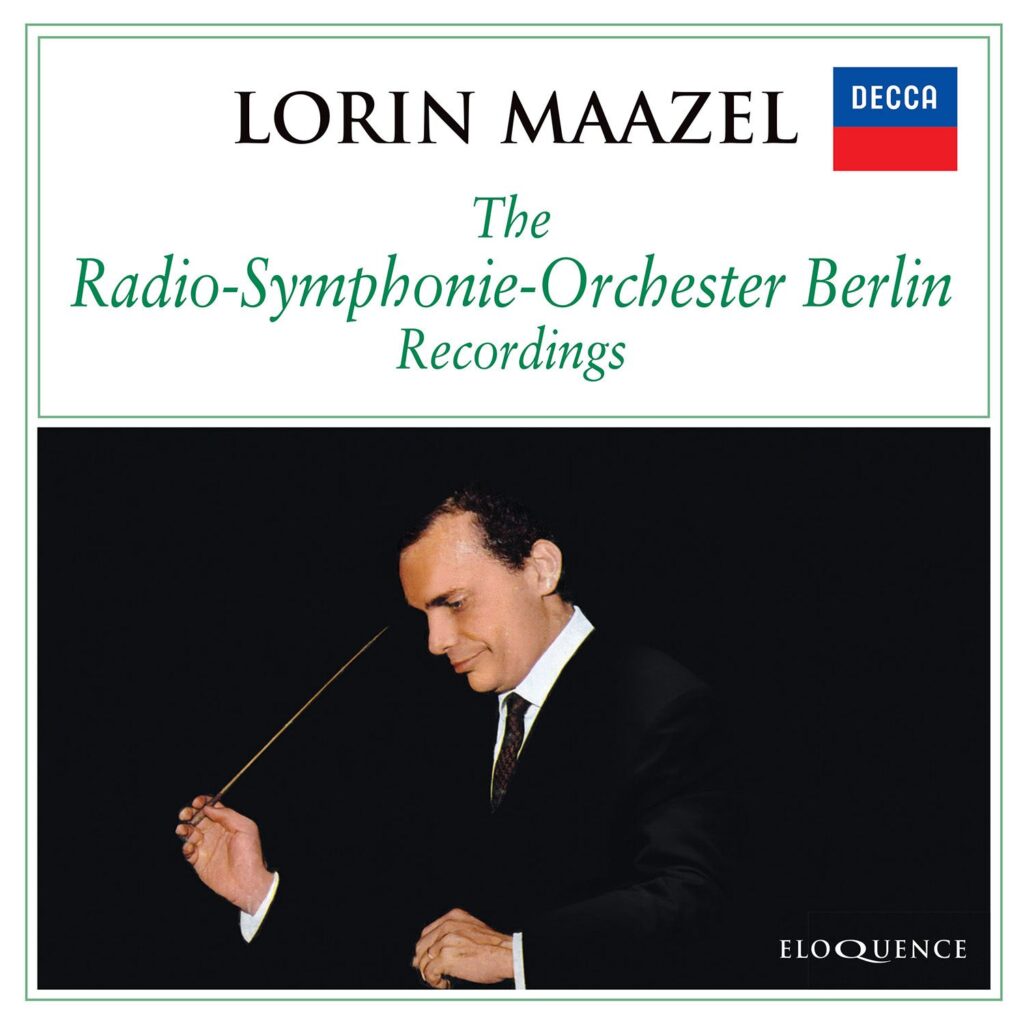
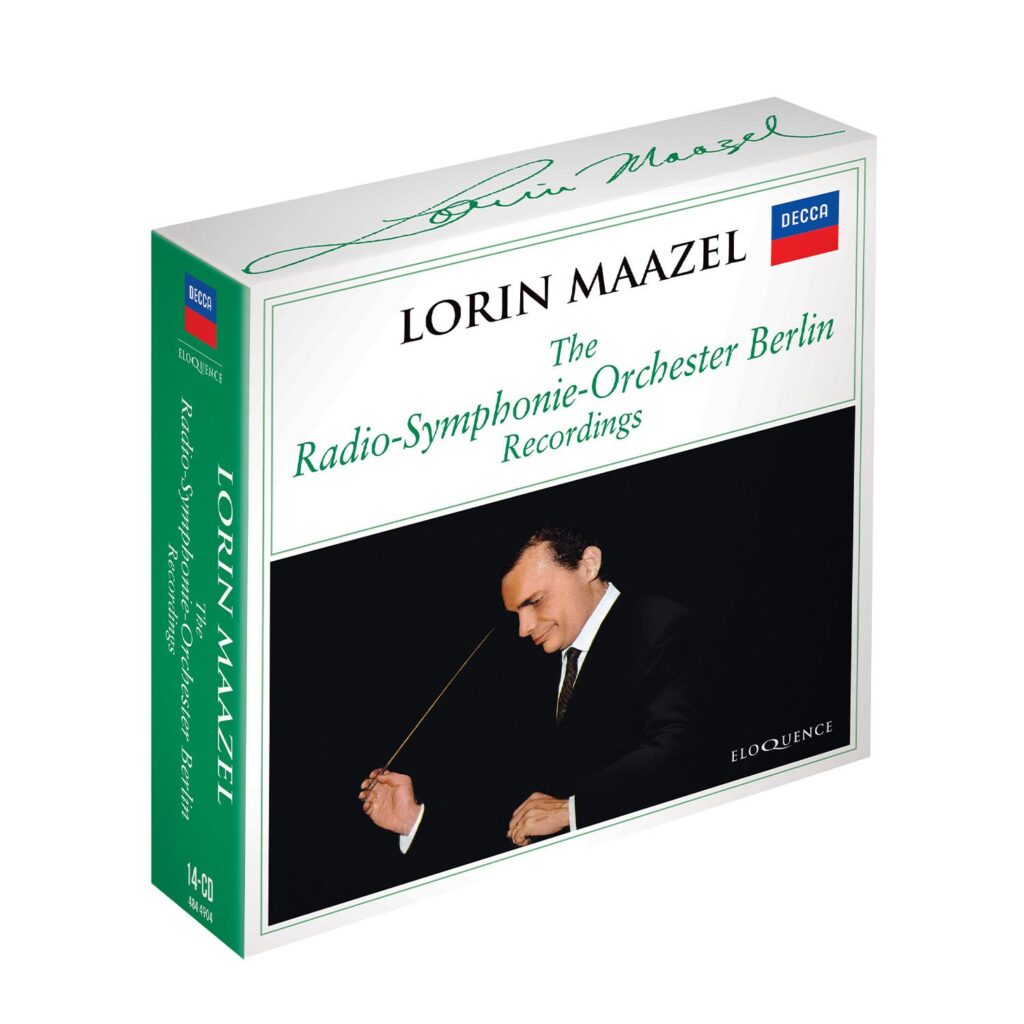
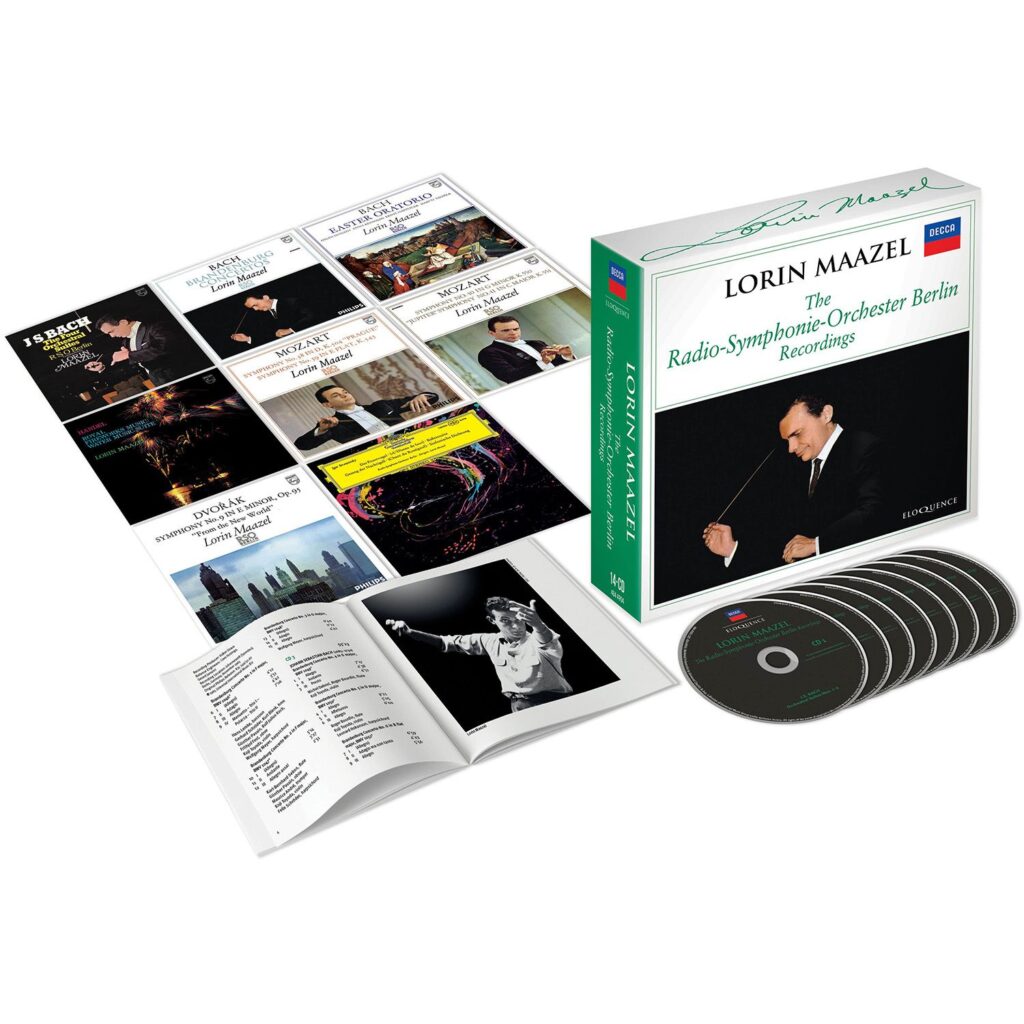
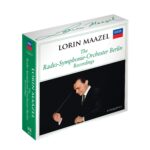
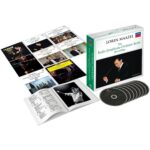
The rich and colourful fruits of Lorin Maazel’s first important orchestral tenure, with the Berlin Radio Symphony Orchestra: repertoire from Bach to Stravinsky moulded with the conductor’s renowned finesse and attention to detail.
Maazel took over the Radio-Symphonie-Orchester Berlin after the death of Ferenc Fricsay in 1963. He and the orchestra had already worked together extensively, both in concert and on record, ever since he made his Berlin debut with them in 1955. The DG albums of Falla, Franck and Stravinsky are all enduring examples of Maazel’s art at its most sonically brilliant and dynamic, cultivating performances of the greatest agility and contrasts of colour from his players.
For Philips, Maazel and the RSO Berlin recorded mostly Baroque-era repertoire in an intensive series of sessions shortly after the beginning of his tenure as music director in September 1965. The Philips engineers had found an acoustically optimal venue at a church in the Spandau suburb of Berlin, and they set down several major works by Bach as well as the Water and Fireworks Music of Handel and the Stabat Mater by Pergolesi, with a magnificent vocal duo in Evelyn Lear and Christa Ludwig.
Even at the time, the symphonic grandeur of Maazel’s interpretations was regarded as running counter to commonly accepted notions of Baroque style. But then, as he explained to an interviewer, ‘We cannot recreate the outer circumstances that gave rise to artistic works of the past … What we can and should do is try as best we can to live up to their greatness in our own manner.’
Maazel’s manner is not so much old-fashioned as individualistic in its contrasts of tempo, smoothly cultivated string sound and high-impact attacks: this is hi-fi spectacular Bach. The Philips series continued with symphonies by Mozart (Nos. 38-41) and Dvorak (No. 9), also raised to rare peaks of expressive intensity. These recordings have never been compiled before, and they shed fresh light on the spectacular early career of a prodigy of the baton. Original Cover artwork is complemented by archive photography and a new essay on Maazel’s Berlin years by Peter Quantrill.
CD 1
J.S. BACH Orchestral Suites Nos. 1–3
CD 2
J.S. BACH Orchestral Suite No. 4
Brandenburg Concertos Nos. 1–3
CD 3
J.S. BACH Brandenburg Concertos Nos. 4–6
CD 4
J.S. BACH Oster-Oratorium
Helen Donath ∙ Anna Reynolds
Ernst Haefliger ∙ Martti Talvela
RIAS-Kammerchor
CDs 5-6
J.S. BACH Mass in B minor
Teresa Stich-Randall ∙ Anna Reynolds
Ernst Haefliger ∙ John Shirley-Quirk
RIAS-Kammerchor
CD 7
HANDEL Music for the Royal Fireworks
Water Music
CD 8
PERGOLESI Stabat Mater
Evelyn Lear ∙ Christa Ludwig
RIAS-Kammerchor
CD 9
MOZART Symphonies Nos. 38 & 39
CD 10
MOZART Symphonies Nos. 40 & 41
CD 11
DVOŘÁK Symphony No. 9 ‘From the New World’
CD 12
FRANCK Symphony in D minor
CD 13
STRAVINSKY The Firebird: Suite
Le Chant du rossignol
CD 14
FALLA El amor brujo
El sombrero de tres picos
Grace Bumbry
“Maazel’s dramatic approach parallels to a large extent that of Paray.” High Fidelity, May 1962 (Franck: Symphony)
“The recording is smooth and atmospheric, everything that is needed for really plushy performances which … have no rival in their own line.” Gramophone, April 1966 (Bach: Orchestral Suites)
“Grace Bumbry has not only a rich, well-managed voice but a true understanding of the style … Exuberance of spirit; splendid playing, with great finesse of tonal gradations and first-rate attack in the farruca; excellent balance.” Gramophone, April 1966 (Falla)
“Lorin Maazel gets some marvellously polished playing from the Berlin Radio Orchestra … The dance episodes from The Three-Cornered Hat come off under Maazel’s baton with polish, elan and great transparency of texture.” Stereo Review, September 1966
“Beautiful, transparent singing … the marvellous Qui tollis is as moving as always.” High Fidelity, September 1966 (Bach: Mass in B minor)
“Maazel’s accent on the tragic and lugubrious elements makes a strong impact … Fairly operatic in style, which is all to the good, and the two vocalists are excellent, as is the chorus.” Stereo Review, August 1967 (Pergolesi)
“The Fireworks Music is played rather well … [the Water Music is] done in enjoyable fashion.” High Fidelity, October 1967 (Handel)
“Maazel’s interpretation is on the whole a very good one … The Philips recording is astonishingly good in its realism … high standard of singing by both soloists and chorus.” Stereo Review, October 1968 (Bach: Easter Oratorio)
“I would recommend to you Maazel’s recording: a large orchestra version, full of shadings and nuances, all meticulously played and brought off in virtuoso fashion.” Stereo Review, September 1969 (Mozart: Symphony No.38)
“Very brilliant and crisply detailed performances, with the woodwind and percussion of the [RSO Berlin] sounding especially vivid and characterful … would be a highly recommendable disc even at full price.” Gramophone, April 1975 (Stravinsky)
“A most beautifully shaped account both in terms of overall structure and incidental beauty of detail. Yet, though each phrase is sensitively moulded, there is no sense of self-conscious striving for beauty of effect.” Gramophone, April 1976 (Franck)
“Maazel approaches the scores in a traditional way … the RSO Berlin provides excellent orchestral work, with a measure of electricity added by the high trumpets led by the one-and-only Maurice André.” Fanfare, September 1980 (Bach: Orchestral Suites)
“An appealingly opulent performance by Maazel and Company. Uniformly good soloists.” Fanfare, May 1982 (Bach: Easter Oratorio)
“Not only is the playing superlative – was still very much Ferenc Fricsay’s Berlin Radio Symphony – but the actual recording is also a harbinger of the classic DG sound to come: warm, slightly distant, but with plenty of punch and detail.” Fanfare, November 2014 (Stravinsky)